



Singapore processes more new company registrations per year than any other city-state in the world.
The reason is not one headline number but a stack of structural advantages that compound: 17% corporate tax on a territorial basis, zero capital gains, zero dividend withholding, and a startup exemption that brings the effective rate below 5% for three years. Add English common law, a 90-plus treaty network, and incorporation in under 48 hours, and you have the jurisdiction that makes Singapore for entrepreneurs the benchmark across Asia.
Why Singapore for entrepreneurs pulls founders from everywhere
Singapore sits at the geographic center of a 650-million-person consumer market, with free trade agreements covering the EU, Australia, India, the US (through USSFTA), and the broader ASEAN bloc. The legal system is English common law, contracts are enforced predictably, and corruption is functionally nonexistent (Transparency International ranks Singapore consistently in the top five globally). For a founder building a B2B SaaS company serving Southeast Asian enterprise clients, or a fintech structuring cross-border payments, those facts change the cost of doing business at every level.
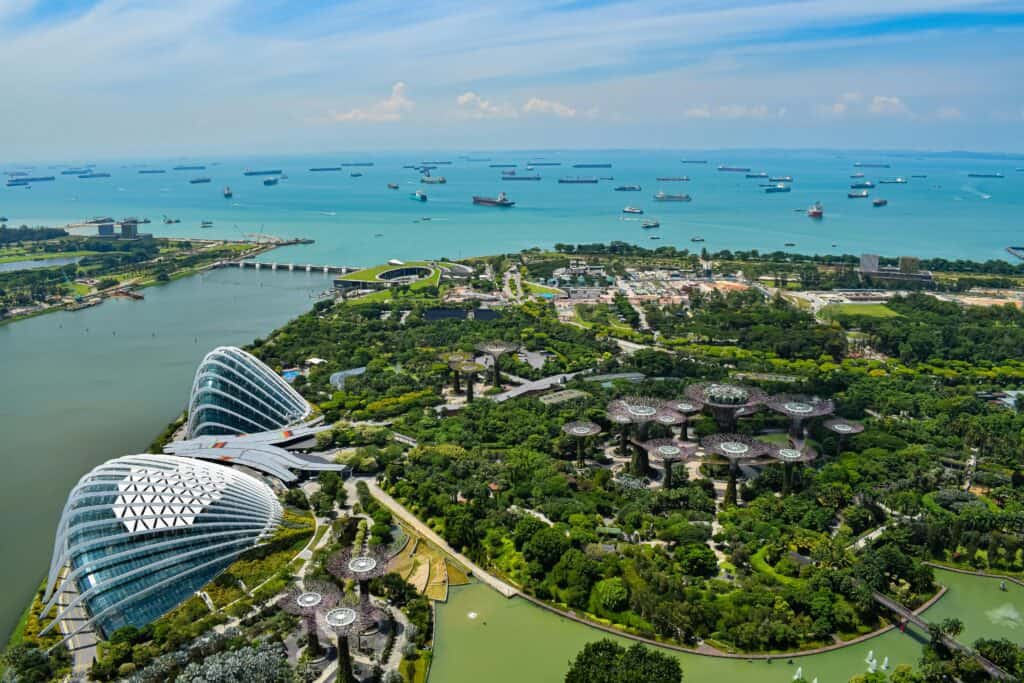
Beyond the macro picture, Singapore offers regulatory clarity that materially reduces your professional services bill. IRAS (the Inland Revenue Authority of Singapore) publishes detailed e-tax guides on every significant issue. ACRA (Accounting and Corporate Regulatory Authority) processes most corporate filings through a self-service portal. You don’t need to hire a consultant to understand the rules because the rules are written in plain English and published online. In my experience, Singapore founders spend roughly half what Hong Kong founders spend annually on corporate secretarial and compliance work in the first two years.
Company formation and ownership structure
Incorporation process
The standard vehicle for Singapore for entrepreneurs is the Private Limited company (Pte Ltd), incorporated through ACRA’s BizFile+ portal. Foreign nationals can own 100% of the share capital with no requirement for a local shareholder or partner.
The sole structural requirement is one resident director: a Singapore citizen, permanent resident, or holder of a valid work pass (Employment Pass holders with a Letter of Consent from MOM qualify). If you don’t yet have a work pass at the point of incorporation, you need a nominee resident director, which must now be arranged through an ACRA-registered Corporate Service Provider (CSP) following the Corporate Service Providers Act 2024, which took effect June 9, 2025. Market rates for nominee director services run from S$1,200 to S$3,000 per year through registered CSPs.
Incorporation itself takes one to two business days once documents are in order. You’ll need your company name (checked against ACRA’s registry), a Singapore-registered office address, details of directors and shareholders, and the company’s primary business activity (SSIC code). ACRA does not automatically issue a Certificate of Incorporation; instead, the BizFile company profile (free, instant) serves as the central reference document. An optional paid Certificate of Incorporation costs S$50.
Director and company secretary obligations
Under Section 171 of the Companies Act, every Singapore Pte Ltd must appoint a company secretary within six months of incorporation. The secretary must be ordinarily resident in Singapore, and the sole director cannot double as company secretary. Most founders engage their CSP for this at S$300 to S$2,000 per year depending on service level. This is a mandatory legal requirement, not an optional add-on.
Audit exemption
Private companies qualify for the small company audit exemption if they meet at least two of three criteria (annual revenue of S$10 million or less, total assets of S$10 million or less, and 50 or fewer employees) for two consecutive financial years. The old exempt private company regime was abolished in 2015. If your company belongs to a corporate group, the exemption applies at both entity and group level; the group must independently satisfy the same two-of-three criteria on a consolidated basis.

Paid-up capital strategy
Singapore has no minimum paid-up capital requirement. You can incorporate a Pte Ltd with S$1. But the number you choose sends signals to three audiences. MOM evaluates your company’s financial capacity when processing EP applications; a company with S$1 in paid-up capital applying to sponsor a founder at S$6,000 per month salary raises questions about viability.
Banks assess paid-up capital during corporate account opening; DBS and UOB are more comfortable onboarding a company capitalized at S$50,000 than one at S$1,000. And future investors will look at your initial capitalization structure when evaluating whether the founders took the venture seriously.
My standard advice: capitalize with enough to cover 12 months of your intended EP salary plus three months of projected operating expenses. For a founder planning a S$6,000 monthly salary with S$5,000 in monthly overheads, that puts the initial paid-up capital at S$87,000. This is not a legal requirement; it is a practical positioning decision that smooths your path through MOM, banks, and eventual investors.
Branch offices and representative offices
Foreign companies can register a Singapore branch rather than incorporating a fresh Pte Ltd, but branches are tax-resident in their home jurisdiction, which eliminates access to Singapore’s startup tax exemptions. Representative offices cannot generate revenue and are restricted to market research and liaison functions. For most founders, the Pte Ltd remains the correct structure.
Tax framework and startup incentives in Singapore for entrepreneurs
Corporate tax rates and structure
Singapore’s corporate tax rate is 17%, applied on a territorial basis. Income earned and sourced outside Singapore is, as a default, not taxable, though Section 10(25) of the Income Tax Act does capture foreign income remitted to Singapore under certain conditions for corporate entities. There is no capital gains tax and no withholding tax on dividends under Singapore’s one-tier corporate tax system. This applies to both resident and non-resident shareholders, which makes Singapore structurally efficient as a regional holding company for founders with operations across multiple ASEAN markets.
Startup Tax Exemption (SUTE)
Newly incorporated companies that are Singapore tax-resident qualify for the Startup Tax Exemption: 75% exemption on the first S$100,000 of chargeable income and 50% on the next S$100,000, for the first three consecutive Years of Assessment. For a detailed comparison of how Singapore’s tax structure compares to a US LLC or Dubai FZE, see the LLC vs Singapore Pte Ltd vs Dubai FZE guide. The maximum exemption per YA is S$125,000, which translates to an effective rate of approximately 4.25% on the first S$100,000 and 8.5% on the next S$100,000.
SUTE eligibility requires all four of the following: the company must be incorporated in Singapore; it must be Singapore tax-resident for that YA (meaning control and management are exercised in Singapore); total share capital must be held by no more than 20 shareholders throughout the basis period; and at least one shareholder must be an individual holding a minimum 10% of issued ordinary shares. Investment holding companies and property development companies are excluded.
Partial Tax Exemption (PTE)
Once SUTE expires after the first three YAs, companies transition automatically to the Partial Tax Exemption: 75% on the first S$10,000 of normal chargeable income and 50% on the next S$190,000. PTE is ongoing, not time-limited, and requires no tax residency (unlike SUTE). Maximum annual PTE benefit is S$102,500.
GST registration strategy
GST registration becomes mandatory once your annual taxable turnover exceeds S$1 million, but voluntary registration below that threshold is worth serious consideration if your client base is primarily GST-registered businesses. When you charge GST on your invoices, your clients claim it back as input tax, so it costs them nothing. Meanwhile, you recover GST on your own business expenses (rent, software subscriptions, professional services, equipment). For a startup spending S$80,000 per year on GST-bearing expenses, voluntary registration recovers approximately S$7,200 annually.
The catch: once registered, you must remain registered for at least two years, file quarterly GST returns, and comply with record-keeping requirements. If your clients are overseas (zero-rated exports), the calculus shifts further in your favor since you charge 0% GST on exports but still claim input tax on local expenses. I register most of my clients voluntarily in their first year if their cost base is predominantly Singapore-sourced.
CIT Rebate YA 2026
Following the April 2026 ministerial statement by DPM Gan Kim Yong, the Corporate Income Tax Rebate for YA 2026 was enhanced to 50% of tax payable, with a combined cap of S$40,000 (rebate plus cash grant). These enhanced figures replaced the original Budget 2026 parameters of 40% rebate, S$1,500 cash grant, and S$30,000 combined cap, announced on February 12, 2026.
Active companies with at least one local employee who received CPF contributions in 2025 (excluding shareholder-directors) receive a minimum S$2,000 as a CIT Rebate Cash Grant, applied automatically by IRAS.
Government grants
The Productivity Solutions Grant covers up to 50% of costs for Singapore-registered companies adopting pre-approved digital tools, software, and equipment. Foreign-led companies are eligible provided the entity is incorporated in Singapore.
The Enterprise Singapore Startup SG Founder scheme provides S$20,000 to S$50,000 in 1:1 matched capital plus mentorship through an Accredited Mentor Partner. Applicants must be first-time founders (Singapore citizen or PR) with at least S$10,000 in paid-up capital at the point of application.
The EDB’s Global Founder Programme supports seasoned foreign entrepreneurs with relocation assistance, investor introductions, and scaling support for high-growth businesses.
Banking: opening a corporate account
Corporate banking in Singapore for entrepreneurs is functional but not frictionless for newly incorporated foreign-led companies. The three main local banks (DBS, UOB, and OCBC) all require in-person verification for at least one director or authorized signatory. For the complete guide to opening a corporate bank account in Singapore or Hong Kong as a non-resident, including apostille requirements and fintech alternatives, see the dedicated Singapore vs Hong Kong business banking guide.
Processing times for new accounts run from one to four weeks depending on the bank and business profile. DBS Multiplier and UOB BizMight are the most commonly used accounts for early-stage startups; OCBC Business Growth Account suits simpler fee structures.
For the in-person appointment, you’ll need your BizFile company profile, NRIC or passport for all directors and shareholders, proof of business address, a completed bank application form, and (for DBS and UOB) a business plan or description of operations if revenue has not yet commenced.
Fintech alternatives are increasingly viable for day-to-day operations. Wise Business and Airwallex are the two leading fintech options for Singapore Pte Ltd entities. Wise charges a one-time setup fee of S$99 and offers FX from 0.26% on major corridors, with ATM withdrawals fee-free up to S$100 per month (then 1.75% on excess). Airwallex Singapore offers three tiers: Explore at S$0/month, Grow at S$79/month, and Accelerate at S$399/month, with 1% cashback on all card spend (local and international). Both are suitable as operational accounts for invoice settlement and multi-currency management, though neither replaces a licensed bank account for payroll, CPF contributions, or government grant disbursements.
My standard recommendation for new founders is to open a DBS or UOB account as the primary compliance account (payroll, CPF, government transactions) and layer Airwallex or Wise on top for FX operations and card spend.
VC and funding ecosystem
Active VC funds and round sizes
Singapore hosts one of Asia’s densest concentrations of venture capital outside of China and India. Funds with active Singapore portfolios include Sequoia Southeast Asia (seed to Series B, S$500,000 to S$30 million), Jungle Ventures (Series A to B, S$5 million to S$30 million, Southeast Asia focus), Monk’s Hill Ventures (seed to Series A, S$1 million to S$10 million), Vertex Ventures Southeast Asia and India (Series A to B, S$5 million to S$50 million), 500 Global (pre-seed to seed, S$200,000 to S$2 million), Lightspeed Venture Partners (growth, Series B onward), and Accel (Series A to growth stage). B Capital Group operates from Singapore with a global mandate and checks from S$10 million upward.
Preferred investment sectors in 2026 cluster around enterprise SaaS, fintech and payments infrastructure, climate tech, and AI-driven logistics.
Government co-investment programs
Enterprise Singapore’s Startup SG Equity program co-invests alongside accredited private investors at a 1:2 ratio (government matches S$1 for every S$2 raised from private investors), with a cap of S$2 million in government co-investment per company. The MAS Financial Sector Technology and Innovation (FSTI) scheme provides direct grants and matching funding for fintech companies building core financial infrastructure. For deep-tech ventures, the National Research Foundation’s support programs (administered through NRF) provide non-dilutive funding at proof-of-concept and early commercialization stages.
Incubators worth engaging include JTC LaunchPad at one-north (Singapore’s main tech cluster), NUS Enterprise (linked to National University of Singapore’s research pipeline), and the Plug and Play Singapore accelerator (corporate-sponsored, sector-agnostic).
Alternative financing
For founders who are not raising VC, Singapore has two workable non-equity options. The Enterprise Singapore SME Working Capital Loan provides up to S$500,000 at below-market rates with a government risk-share of 50%, available through participating banks including DBS, UOB, OCBC, and Standard Chartered. Processing takes two to four weeks, and repayment terms run up to five years. Revenue-based financing is available through providers active in the Singapore market, with blended costs running at 6% to 12% annually depending on revenue profile and repayment structure. Trade financing facilities through DBS and UOB are well-developed for companies with purchase orders or receivables from corporate clients.
One option that founders overlook is the Enterprise Singapore Enterprise Financing Scheme (EFS) Trade Loan, which covers up to S$10 million per borrower for trade-related financing needs with a government risk-share of 70%. This is separate from the Working Capital Loan and is relevant if your Pte Ltd imports physical goods or raw materials from regional suppliers. Processing runs two to three weeks through participating banks. If your business model generates recurring revenue (SaaS, subscription services), ask your bank about invoice financing facilities before taking equity dilution; DBS and UOB both have structured facilities for this starting from S$100,000 in receivables.
Regional cost comparison: Singapore for entrepreneurs vs. peers
The table below uses approximate 2026 figures. Office rent is for Grade B space; tech salary is for a mid-level software engineer (three to five years experience); apartment is a two-bedroom in a central expat district; tax rate is the headline corporate rate.
| Cost metric | Singapore (SGD) | Hong Kong (HKD) | Kuala Lumpur (MYR) | Bangkok (THB) |
|---|---|---|---|---|
| Office rent (per sqm/month) | 80-120 | 200-350 | 25-50 | 400-700 |
| Mid-level tech salary (annual) | 72,000-96,000 | 360,000-480,000 | 72,000-108,000 | 600,000-900,000 |
| 2BR expat apartment (monthly) | 4,500-7,000 | 20,000-35,000 | 3,000-5,500 | 25,000-45,000 |
| Corporate tax rate | 17% | 16.5% | 24% | 20% |
| Capital gains tax | None | None | None | None |
| Dividend withholding tax | None | None | None | 10% |
Singapore is the most expensive operating environment in the table, but the combination of zero capital gains, zero dividend WHT, and access to government grants materially narrows the effective cost gap for profitable companies.
Employment law and talent strategy in Singapore for entrepreneurs
Core legislation and CPF
Singapore’s Employment Act covers all employees (except domestic workers and seafarers) with differentiated protections by employment type and salary level. Founders who are evaluating whether to hire directly or use an EOR should review the guide to EOR vs local entity vs contractor for a detailed cost and compliance comparison across Singapore, Hong Kong, and Dubai. Part IV of the Act (hours of work, overtime) applies to workmen earning up to S$4,500 per month and non-workmen earning up to S$2,600 per month; managers and executives are excluded from Part IV regardless of salary.
Mandatory CPF (Central Provident Fund) contributions apply to all Singapore citizens and permanent residents employed in Singapore. The employer contribution rate is 17% and the employee rate is 20%, applied on monthly wages up to the Ordinary Wage ceiling of S$8,000 (as of January 1, 2026, the final step in the phased increase schedule). Foreign nationals on work passes are exempt from CPF. Foreign directors are also exempt. Contributions are made monthly to CPF Board and are due by the 14th of the following month.
Work passes and salary thresholds
The Employment Pass (EP) is the standard work visa for professionals and founders. The minimum qualifying salary is S$5,600 per month (S$6,200 for financial services) since January 1, 2025, with a planned increase to S$6,000 (S$6,600 for financial services) from January 1, 2027. All EP applications require COMPASS scoring, a points-based framework assessing salary benchmarking, qualifications, diversity contribution, and company support for local employment. Application fees are S$105 (non-refundable) plus S$225 on issuance.
The S Pass is the mid-tier work pass for associate professionals. Minimum salary is S$3,300 per month (S$3,800 for financial services) since September 2025. Companies sponsoring S Pass holders are subject to a quota (not more than 10% of the local workforce in most sectors) and a monthly levy.
The Tech Pass is a five-year visa for senior technology professionals, with a minimum monthly salary threshold of S$22,500. It is not tied to a single employer, allowing holders to work for multiple companies and start their own ventures.
The ONE Pass targets individuals earning at least S$30,000 per month or with outstanding achievements in their field. It is valid for five years, not employer-tied, and allows dependants automatic work authorization.
ESOP norms and talent retention
Stock options in Singapore follow IRAS guidelines on the taxation of employee share plans: options are taxed at exercise (not grant) on the difference between market value and exercise price, treated as employment income. A four-year vesting schedule with a one-year cliff is the standard for early-stage companies. The primary talent retention challenge in Singapore is not compensation structure but competition from multinational corporations. MNCs headquartered in Singapore compete directly for mid-tier software engineers and product managers, driving base salary expectations upward. Founders who cannot match MNC base salaries need to make the equity case clearly at the offer stage.
Visa and immigration for entrepreneurs
Entrepreneur Pass (EntrePass)
The EntrePass is MOM’s dedicated visa for foreign founders without an existing corporate vehicle to sponsor an Employment Pass. Eligibility requires either venture funding from an accredited investor, a proprietary intellectual property, research collaboration with a Singapore university, or incubation by an approved accelerator. The EntrePass is not the right vehicle if you already have a Singapore Pte Ltd with sufficient paid-up capital; in that case, structuring the company to sponsor your own EP is more straightforward and carries fewer ongoing renewal conditions.

Employment Pass for founders
A newly incorporated Singapore Pte Ltd can sponsor an Employment Pass immediately, with no minimum company age requirement. Paid-up capital should cover at least 12 months of the applicant’s gross salary before filing. Founders holding shares directly in the sponsoring entity face additional MOM scrutiny; I’ve seen cleaner approvals where a holding company in another jurisdiction holds the Singapore operating company shares, with the founder sponsored by the operating entity as an employee-director.
Permanent residency and citizenship
The PR pathway runs through either the Professional, Technical Personnel and Skilled Workers (PTS) scheme or the Global Investor Programme (GIP). Under PTS, a minimum of one to two years of continuous employment in Singapore on a valid work pass is the baseline, though median processing time from strong applications has been two to four years in practice. The GIP requires a minimum investment of S$10 million in a Singapore business or S$25 million in a GIP-approved fund (as of the 2023 revision), with PR granted in three to six months.
Citizenship eligibility opens after two years of PR. Singapore does not permit dual citizenship; you must renounce all other citizenships on naturalization.
In practice, the PR application process for EP holders is opaque and outcome-dependent on factors ICA does not publish. Founders who employ local staff, generate revenue in Singapore, and maintain continuous residence have materially stronger profiles than those who use Singapore as a brass-plate holding structure. I have seen PR approvals for founder-directors after as little as two years on EP, and rejections after five years for individuals who spent most of their time outside Singapore. The signal ICA responds to is genuine economic contribution, not paper residency.
Dependant Pass and family integration
Work pass holders at EP level (not S Pass) can sponsor a Dependant Pass for spouses and children under 21. Dependant Pass holders can apply for a Letter of Consent to work in Singapore without needing a separate work pass. Long-Term Visit Passes (LTVP) are available for parents and common-law partners, though LTVP holders cannot work without a separate authorization.
Housing for expat founders
Districts and typical costs
When evaluating Singapore for entrepreneurs, the most common housing choices are the Core Central Region (Districts 9, 10, and 11: Orchard, Holland Village, Buona Vista), the East Coast (Districts 15 and 16), and the one-north area (District 5), which sits adjacent to the JTC LaunchPad tech cluster and Biopolis. A two-bedroom apartment in Districts 9 and 10 runs from S$4,500 to S$7,000 per month. East Coast equivalents range from S$3,500 to S$5,500. One-bedroom units in one-north and Queenstown range from S$2,800 to S$4,200.

Lease terms and costs
Standard residential leases are 12 or 24 months with a two-month security deposit plus one month’s advance rental at signing. Agent commissions on rental are regulated by the Council for Estate Agencies: one month’s rental for leases of 12 months or more, paid by the landlord for leases above S$3,500 per month. Budget a total upfront commitment of three months’ rent at signing. Many landlords require proof of work pass or EP approval letter before executing a lease; time your housing search for the two-to-four-week window after EP issuance.
Furnished apartments are the norm in the expat rental market and command a 10 to 15% premium over unfurnished units. If you are arriving without furniture, this saves you S$5,000 to S$15,000 in upfront furnishing costs and keeps you mobile if your first location does not work out. Most leases include an early termination clause (the “diplomatic clause”) allowing you to break the lease after 12 months of a 24-month contract with two months’ written notice, provided you have a qualifying reason (job relocation, repatriation). Negotiate this clause before signing; it is standard market practice but not automatic.
For founders who want to stay close to the tech ecosystem without paying District 9 or 10 rents, the Queenstown and Buona Vista corridor offers newer condominiums at S$3,200 to S$4,800 for a two-bedroom, with direct MRT access to both the CBD and one-north in under 15 minutes.
Daily life and logistics
Singapore operates as a full-service expat city. Public transport (MRT and bus) covers the entire island with fares from S$0.80 to S$2.50 per trip; monthly commuting costs for a couple without a car run around S$180. Taxis and Grab (the dominant ride-hailing platform) are affordable by developed-economy standards.
Safety is not a marketing claim here. Singapore consistently ranks as Asia’s safest city by multiple indices, and the practical experience matches the statistics: zero concern about petty crime, bag theft, or personal safety at any hour in any part of the island. Climate is equatorial: hot and humid year-round (30-33°C), with no seasonal variation worth planning around. Air quality is good except during annual haze events from Indonesian forest fires (June to October).
Co-working space is plentiful. JTC LaunchPad at one-north is the flagship tech cluster, offering below-market space for qualifying startups. WeWork, The Work Project, and Spaces operate across Orchard, Marina Bay, and the CBD. Rates for a dedicated desk run from S$400 to S$800 per month; private offices from S$1,500 to S$3,500 monthly for a four-person unit.
English is the working language of business, government, and the legal system. You will not need a translator for any corporate, banking, or regulatory interaction. Mandarin, Malay, and Tamil are co-official languages, and most Singaporeans are bilingual. Grocery costs for a couple run S$800 to S$1,500 per month depending on whether you shop at FairPrice (local supermarket chain) or Cold Storage and Marketplace (expat-oriented, 30 to 50% premium).
Eating out is bifurcated: hawker centres serve meals at S$4 to S$8 per dish, while restaurant dining runs S$30 to S$80 per person for a mid-range meal with drinks. Most founders I know eat at hawker centres four days a week and save restaurants for client meetings. Gym memberships at commercial chains (Anytime Fitness, Fitness First) cost S$100 to S$200 per month; boutique fitness studios (Barry’s, F45) run S$250 to S$400.
Healthcare and family costs in Singapore for entrepreneurs
Expat health insurance
Individual full-coverage health plans from major providers (Aetna, Allianz Care, AIA, BUPA) run from S$100 to S$300 per month for ages 25 to 45. Family plans covering two adults and two children range from S$400 to S$800 per month, depending on outpatient coverage limits and hospitalization tier. Singapore’s public hospital system (restructured hospitals including SGH and NUH) is available to residents with MediShield Life coverage, but most expat founders opt for private hospitalization cover, which provides access to private hospitals and specialist choice without waitlists.

International school fees
Singapore has a dense international school market. Top-tier schools (Singapore American School, United World College, Tanglin Trust) charge S$25,000 to S$40,000 per year per child. Mid-tier international schools (Chatsworth International, Australian International School) range from S$18,000 to S$26,000 per year. Waiting lists at the top tier are long; start the enrollment process as early as six to twelve months before your intended start date. School fee payments are not eligible for CPF use and must be funded from disposable income.
Childcare and preschool options
For founders with children under six, Singapore’s childcare market splits into three tiers. Government-subsidized centers (PCF Sparkletots, NTUC My First Skool) charge S$700 to S$1,300 per month for full-day care, but waitlists are long and priority goes to citizens. Private preschools and kindergartens (MindChamps, EtonHouse, Pat’s Schoolhouse) run S$1,200 to S$2,500 per month.
International preschools (the early years programs at Tanglin Trust, UWCSEA, Stamford American) charge S$2,000 to S$3,500 per month. Foreign families on EP are eligible for all three tiers, but the government subsidy (up to S$600 per month) applies only to children of Singapore citizens. Budget your childcare costs at the private or international tier.
Monthly family budget
A couple without children, living centrally, can expect monthly costs of approximately: S$4,500 to S$6,500 for a two-bedroom apartment, S$1,500 to S$2,500 for groceries, utilities, and transport, S$300 to S$500 for dining out three to four times per week, and S$200 to S$400 for health insurance. Total monthly burn without international school fees: S$7,000 to S$10,000. With one child at a mid-tier international school, add approximately S$1,800 per month.
2026 startup events and ecosystem networking
Singapore for entrepreneurs includes a structured events calendar that functions as genuine deal-flow and partnership infrastructure, not just content marketing. Notable 2026 events include:
- Entrepreneur Asia Summit and Awards (February 13, Hotel St. Regis): Annual recognition and networking event for regional founders and investors.
- CNBC Converge LIVE (April): Regional tech leadership conference with senior MNC and VC participation.
- TechCrunch Founder Summit Singapore (June 23): International deal-flow event, strong for pre-Series A founders seeking cross-border investor introductions.
- The Business Show Asia (August 26 to 27, Sands Expo and Convention Centre): Singapore’s largest SME and startup event, expecting 8,000-plus attendees across two days. Covers growth strategies, funding, digital tools, and market expansion across ASEAN.
Beyond marquee events, Singapore runs a dense calendar of sector-specific meetups and founder dinners. Singapore Fintech Festival (November, organized by MAS) draws 60,000+ participants and is the largest fintech event in Asia. Echelon by e27 (June) focuses on early-stage startups with a pitch competition format. For weekly networking, the Founders’ Forum at BLOCK71 and the NUS Enterprise Wednesday Series provide consistent access to the local ecosystem without conference fees.
90-day action plan
Days 1 to 30: foundation
Appoint a registered CSP and complete Pte Ltd incorporation through ACRA BizFile+. Confirm nominee director arrangement (if required), company secretary appointment, and registered office address. Capital up with at least 12 months of your intended EP salary if sponsoring yourself. Open a DBS or UOB corporate account by booking an in-person appointment at the earliest available slot; prepare BizFile profile, passports of all directors, and a one-page business description. Set up Xero or QuickBooks for bookkeeping from day one. Register for GST if you project SGD 1 million in taxable turnover within 12 months (registration threshold for compulsory registration with IRAS).

Days 31 to 60: passes and workspace
File EP application through MOM’s EP Online portal (processing takes three to eight weeks). Secure co-working space at JTC LaunchPad (apply via JTC Corporation portal) or a commercial co-working provider. Engage with Enterprise Singapore’s Startup SG Founder program: prepare a pitch deck and business plan for the initial assessment meeting. Identify your first two to three ASEAN market targets and begin outbound outreach. Hire your first Singapore-based contractor (no CPF required) or employee (CPF required if Singapore citizen or PR); confirm employment contract terms against the Employment Act framework.
Days 61 to 90: compliance foundations and growth
Complete ACRA annual return baseline: confirm financial year end (most founders choose December 31 or March 31), appoint auditors if not exempt, and confirm company secretary has the compliance calendar in place. File first GST return if registered. Apply for the Productivity Solutions Grant for any pre-approved digital tools (accounting software, CRM, cybersecurity tools). Attend at least one ecosystem event (check the Singapore Business Federation or Enterprise Singapore event calendar for monthly programs). Map your COMPASS score for EP renewal twelve months ahead; identify any category where you may need to shore up the points.
Compliance calendar
| Obligation | Deadline | Frequency | Late filing penalty |
|---|---|---|---|
| ACRA annual return | Within 5 months of FYE (listed) or 7 months (private) | Annual | S$300 to S$600 |
| IRAS estimated chargeable income (ECI) | Within 3 months of financial year end | Annual | 5% surcharge on tax payable |
| Corporate income tax (Form C or C-S) | November 30 of the following YA | Annual | 5% of tax unpaid |
| GST return (if registered) | One month after end of each accounting period | Quarterly | 5% of outstanding tax |
| CPF contributions | By 14th of the following month | Monthly | S$200 to S$2,000 plus interest |
| Statutory audit (if required) | Filed with ACRA annual return | Annual | S$5,000 |
| Related-party transactions form | With Form C, if total RPTs exceed S$15 million | Annual | Part of income tax penalty regime |
ECI filing is the most commonly missed early-stage deadline. If your company has nil income in the first year, file a nil ECI within three months of financial year end regardless. IRAS does not waive the requirement automatically.
FAQ
Can foreigners own 100% of a company in Singapore?
Yes. Singapore allows 100% foreign ownership of a Pte Ltd with no requirement for a local shareholder or business partner. The only structural requirement is one resident director (a Singapore citizen, PR, or valid work pass holder). If you don’t have a work pass yet, a nominee director arranged through an ACRA-registered CSP satisfies this requirement.
How long does it take to incorporate a Singapore Pte Ltd?
Incorporation through ACRA BizFile+ takes one to two business days once all documents are in order. Document preparation (director consents, shareholder details, registered address confirmation) takes one to three additional days if done through a CSP. Total timeline from decision to incorporated entity: five to seven business days is achievable.
What are the corporate tax rates and startup exemptions in 2026?
The base corporate tax rate is 17%. New companies qualifying for the Startup Tax Exemption pay an effective rate of approximately 4.25% on the first S$100,000 of chargeable income and approximately 8.5% on the next S$100,000, for three consecutive Years of Assessment. After SUTE expires, the Partial Tax Exemption applies on an ongoing basis. There is no capital gains tax and no dividend withholding tax.
For YA 2026, the enhanced CIT Rebate (50% of tax payable, capped at S$40,000 combined, following the April 2026 ministerial statement) further reduces the effective rate.
What government grants are available for foreign entrepreneurs?
Foreign-led Singapore Pte Ltds can access the Productivity Solutions Grant (up to 50% cost coverage for approved digital tools), the Startup SG Founder grant (S$20,000 to S$50,000 in 1:1 matched capital for first-time founders), and the EDB Global Founder Programme for high-growth international ventures.
What are the major startup events in Singapore in 2026?
The main events include the Entrepreneur Asia Summit and Awards (February 13), CNBC Converge LIVE (April), TechCrunch Founder Summit (June 23), and The Business Show Asia (August 26 to 27 at Sands Expo and Convention Centre), which expects over 8,000 SME and startup attendees.
What visa options exist for international entrepreneurs?
The Employment Pass is the standard route for founders whose Singapore company can sponsor them (minimum S$5,600 per month salary, S$6,200 for financial services). The EntrePass suits founders without an existing corporate vehicle who have VC backing, proprietary IP, or incubator support. The Tech Pass is available for senior tech professionals earning above S$22,500 per month. The ONE Pass targets individuals at S$30,000 per month or with exceptional achievement recognition.
What is the monthly cost of living for a family in Singapore?
A family of four with two children at an international school should budget S$12,000 to S$18,000 per month covering rent, groceries, transport, insurance, and mid-tier school fees. Without school fees, a couple’s monthly costs run S$7,000 to S$10,000 living centrally. Health insurance for a family adds S$400 to S$800 per month depending on coverage level.
How do I hire talent in Singapore as a foreign founder?
Singapore citizens and PRs require CPF contributions: 17% employer contribution plus 20% employee contribution on monthly wages up to S$8,000 (the 2026 Ordinary Wage ceiling). Foreign nationals on work passes (EP, S Pass, Tech Pass) do not require CPF. For mid-level tech talent, expect competition from regional MNCs on base salary. Equity compensation structured with a four-year vest and one-year cliff is standard and is taxed at exercise as employment income under IRAS rules.
Sources
- ACRA: Company incorporation and BizFile guide
- IRAS: Corporate income tax rates and startup tax exemption
- Enterprise Singapore: Startup SG Founder and SME Working Capital Loan
- MOM: Employment Pass and work pass framework 2026
- CPF Board: Contribution rates and Ordinary Wage ceiling
- NRF: National Research Foundation grant programs
- Asia Business Show: The Business Show Asia 2026
- Entrepreneur APJ: Asia startup event calendar


