


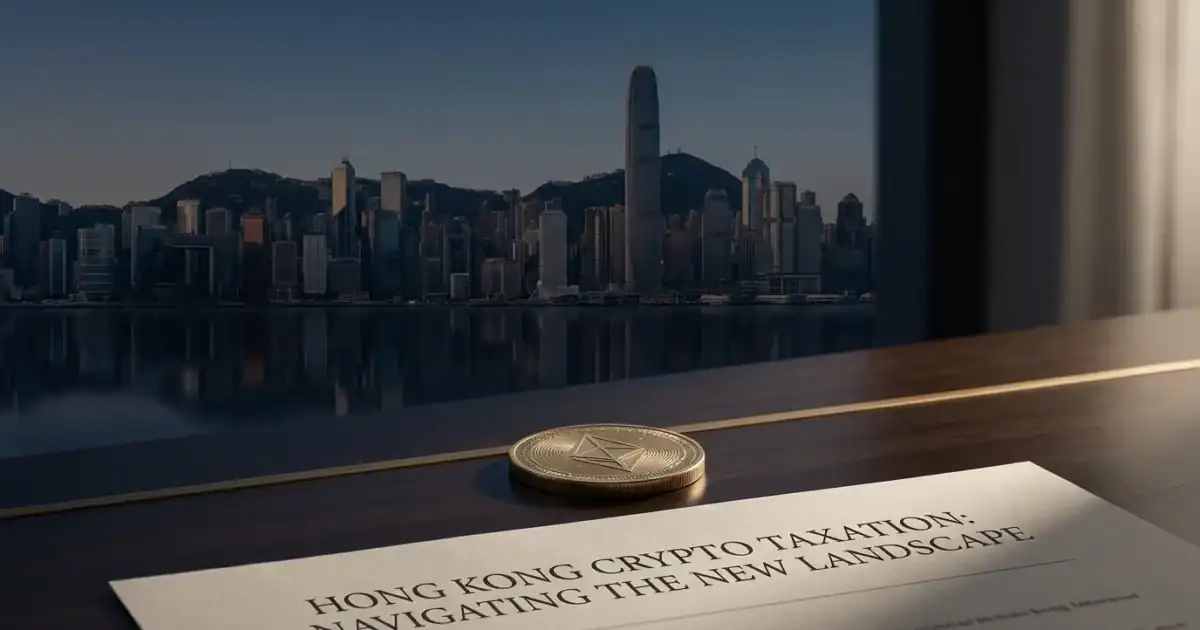
Hong Kong crypto tax treatment in 2026 sits in an unusual position globally: capital gains on Bitcoin and other virtual assets are effectively zero for individual investors, not because of a special exemption carved out for crypto, but because Hong Kong has never taxed capital gains at all. That structural reality makes Hong Kong crypto tax policy less about what the government has done for crypto and more about how existing law happens to benefit crypto holders by default.
The more interesting story is what is changing. The 2025-26 Budget proposed a formal 0% tax outcome for qualifying funds and family offices (pending legislation), OECD’s Crypto-Asset Reporting Framework (CARF) will begin automatic data exchanges in 2028, and the Securities and Futures Commission has built out a mandatory licensing regime that shapes how institutional investors access the market. Zero tax and increasing transparency are arriving together, and understanding both sides is what separates good tax planning from a false sense of security.
What is Hong Kong’s 0% crypto tax policy and who qualifies?
The core rule: no capital gains tax on crypto
Hong Kong’s Inland Revenue Ordinance (Cap. 112) imposes Profits Tax on income derived from a trade or business carried on in Hong Kong. There is no separate capital gains tax. A Bitcoin holder who buys and holds as a genuine long-term investment is not running a trade, so the gain when they sell is not within the tax base. The result is 0% on capital gains, not as a concession to crypto specifically, but as a structural feature of a profits-tax-only system.
The territorial dimension compounds the benefit. Only profits sourced in or derived from Hong Kong are taxable. Crypto gains arising outside Hong Kong, through offshore exchanges, offshore funds, or offshore custodial structures, fall entirely outside the Hong Kong tax net regardless of whether the investor is a Hong Kong resident.
For the large majority of retail investors, this means Hong Kong crypto tax exposure is zero: no capital gains tax, no offshore tax on foreign exchange gains, and no tax on unrealized appreciation.
Individual investor treatment vs. business treatment
The zero-tax outcome depends entirely on classification. A buy-and-hold investor is not taxed. A trader running organized, frequent, profit-driven operations in Hong Kong is taxed as a business at 16.5% (corporate entity) or 15% (unincorporated sole proprietor or partnership) on profits sourced in Hong Kong. Under the two-tier system, the first HK$2 million of assessable profits is taxed at 8.25% (corporate) or 7.5% (unincorporated), with the standard rate applying to the remainder.
The Inland Revenue Department (IRD) applies long-standing “badges of trade” doctrine drawn from case law and Departmental Interpretation and Practice Notes (DIPN 39): frequency of transactions, degree of organization, profit motive, holding period, and whether the activity resembles a commercial enterprise. There is no dedicated crypto-tax statute in Hong Kong as of 2026. The IRD applies existing Profits Tax principles to crypto as it would to any other asset class.
A day trader executing hundreds of transactions per month through structured systems looks like a business. Someone who bought Ethereum in 2021 and sold in 2025 does not.
When does crypto activity become taxable business income in Hong Kong?
Defining taxable crypto business activity
The categories that attract Profits Tax are consistent with the badges-of-trade framework: frequent trading for short-term profit, market-making, commercial-scale mining, staking operations run as a business, and operating exchange platforms or crypto-related services directed at Hong Kong customers. All of these can qualify as trades carried on in Hong Kong.

Casual investors, long-term holders, and one-off transactions fall outside the business umbrella. The IRD does not publish a bright-line transaction count, so judgment calls in the middle range require professional assessment. In practice, I advise clients to document their investment intent at the time of purchase, maintain records of holding periods, and avoid using crypto holdings interchangeably with short-term trading activity in the same entity.
Hong Kong crypto tax rates by entity type
| Investor type | Tax treatment | Rate (2026) |
|---|---|---|
| Buy-and-hold individual | Capital gain (not taxable) | 0% |
| Active trader (sole proprietor/partnership) | Profits Tax on HK-sourced income | 15% |
| Active trader (corporate entity) | Profits Tax on HK-sourced income | 16.5% |
| Commercial miner / staking operator | Profits Tax if HK-sourced business | 16.5% (corporate) |
Source vs. capital distinction: the threshold that matters
The source-based system means that even a trader who is taxable in principle may avoid Hong Kong Profits Tax if the relevant profits are offshore-sourced. A trader physically located in Hong Kong using a foreign exchange whose order execution, counterparty matching, and settlement all occur offshore has a credible argument that the profits are offshore-sourced.
The Hong Kong offshore profits tax exemption framework is well-developed, and the IRD applies an “operations test” to determine where profit arises. However, a trader who uses Hong Kong-based infrastructure, employs Hong Kong staff, or whose decision-making is centered in Hong Kong will have difficulty sustaining an offshore-source argument regardless of where the exchange is incorporated. Physical presence and operational reality matter more than corporate structure on paper. In my experience advising Hong Kong-based traders, the source question is where most disputes with the IRD arise.
Hong Kong’s 2026 fund and family office tax reforms: the formal zero-tax future
Current offshore fund exemption and its limits
Qualifying funds investing in offshore virtual assets already achieve low or zero effective tax under the existing regime: capital gains on held assets are not taxable, and only Hong Kong-sourced trading profits face the 16.5% Profits Tax rate. Funds structured under the unified fund exemption regime (sections 20AM to 20AY of the Inland Revenue Ordinance, effective 1 April 2019) with genuine offshore operations and offshore-sourced gains have operated with effective 0% outcomes for years.
The limitation is residual uncertainty around sourcing. A fund that occasionally trades through Hong Kong-based infrastructure, employs Hong Kong portfolio managers, or holds assets in Hong Kong custodians faces analytical risk about whether some portion of its activity is Hong Kong-sourced. Fund counsel must evaluate each activity against the operations test. That analysis is manageable but creates ongoing compliance cost and some legal exposure.
Proposed legislative changes: virtual asset carve-out (expected 2026)
The 2025-26 Budget announced plans to amend the fund exemption rules to explicitly include virtual assets as eligible investment categories, with a formal 0% tax outcome covering both capital and trading gains for qualifying structures, regardless of where the trading occurs. The intent is to eliminate sourcing ambiguity entirely for funds and family offices: any gain on crypto held within a qualifying structure would be exempt without any need for source analysis.
As of early 2026, the enabling legislation has not been enacted. This is government-backed policy confirmed through the Budget process, but it remains a draft proposal pending legislative passage. Funds structuring around the anticipated exemption should build in contingency for the timeline. I have seen clients over-engineer structures around proposed rules that were delayed or modified on passage; caution is warranted.
Family office expansion and competitive positioning
Family offices managing ultra-high-net-worth private assets will benefit from the same virtual asset exemption once legislation passes. Hong Kong is directly targeting Singapore and UAE competition for regional crypto fund infrastructure. The reform signals that Hong Kong’s policymakers understand 0% capital gains alone is not sufficient when Singapore’s section 13O and 13U fund regimes and UAE free zone structures also offer near-zero effective tax on crypto. A formal statutory guarantee removes the uncertainty premium that has historically made some fund managers hesitate on Hong Kong.
For founders evaluating where to base a crypto-focused investment vehicle, the tax residency decision framework across Singapore, Hong Kong, and Dubai turns heavily on this structural certainty question. Singapore’s Section 13O and 13U fund regimes already provide statutory clarity; the Hong Kong amendment, once passed, would level that playing field.
CARF compliance, crypto asset reporting, and privacy implications
Hong Kong’s commitment to the OECD Crypto-Asset Reporting Framework
Hong Kong has committed to the OECD Global Forum to implement the Crypto-Asset Reporting Framework (CARF), with local legislative amendments targeting completion by end of 2026 and first automatic information exchanges in 2028. CARF is a multilateral standard modeled on the Common Reporting Standard (CRS): exchanges, custodians, and wallet providers operating in or serving Hong Kong will be required to report client crypto holdings, transaction volumes, and counterparty details to the IRD, which then shares the data automatically with treaty partners.

This is the most consequential development in Hong Kong crypto taxation for retail investors who have historically relied on low reporting visibility. The 0% capital gains treatment does not change under CARF. What changes is detection probability for those holding crypto in foreign exchanges who have not properly reported holdings or income.
Impact on current 0% tax benefit and reporting obligations
Investors who hold Hong Kong tax residency and have undisclosed crypto positions in foreign exchanges face material audit risk from 2028 onward. The IRD will receive automatic reports and can cross-reference against tax filings and declared wealth. For most genuine capital investors, this creates no new liability because their gains were not taxable in the first place. The exposure falls on those who had taxable trading income but did not report it, or who have inconsistencies between declared assets and actual holdings.
Institutional investors and funds holding positions through custodians in CARF-participating jurisdictions should begin reconciling their reporting positions now. The 2026-2027 window before first exchanges represents a practical opportunity to clean up any gaps in prior-year treatment. Voluntary disclosure options may be available depending on the specific facts; professional advice specific to the investor’s residency and holding structure is necessary before acting.
The compliance reorientation for Hong Kong crypto investors
The practical consequence is a reorientation of Hong Kong crypto tax planning away from privacy and toward structural legitimacy. Fund wrappers and qualifying family office structures that generate provably exempt gains are cleaner post-CARF than retail exchange holdings that technically produce 0% tax but sit in an information-exchange ecosystem. Structure that was previously chosen for legal certainty becomes doubly valuable once the reporting infrastructure arrives.
Regulatory framework: SFC, HKMA, and how tax rules interact with licensing
VASP licensing and SFC oversight
All crypto exchanges and trading platforms serving the public in Hong Kong must be licensed by the Securities and Futures Commission (SFC) under the mandatory Virtual Asset Service Provider (VASP) regime. Anti-money laundering and counter-terrorist financing (AML/CTF) obligations, investor protection requirements, and operational standards apply. Licensing does not change the tax treatment of gains or income for the platform’s customers, but it ensures that licensed platforms operating in Hong Kong are subject to the data-reporting architecture that will feed into CARF compliance from 2028.

The link between SFC licensing and CARF reporting means that crypto held on licensed Hong Kong exchanges will be fully visible to the IRD once CARF exchanges begin. Investors who thought the Hong Kong crypto tax environment was opaque should update that assumption ahead of 2028.
HKMA stablecoin regime and institutional structuring
The Hong Kong Monetary Authority (HKMA) has implemented a specific prudential regime for stablecoins under the Stablecoins Ordinance, in force since 1 August 2025, coexisting with the SFC’s oversight of trading platforms. The stablecoin rules affect banking access and institutional structuring: banks offering crypto-related services must satisfy both HKMA prudential supervision and IRD tax requirements simultaneously. The stablecoin regime does not itself impose tax but shapes which institutional structures can operationally hold and transact in digital assets within the Hong Kong financial system.
For founders evaluating whether to base crypto operations in Hong Kong versus alternative jurisdictions, the interaction between banking access and tax treatment is material. Opening a business bank account in Hong Kong as a crypto-related entity has historically been difficult; the HKMA’s formal stablecoin framework and the SFC’s VASP licensing regime are intended to normalize institutional banking relationships for licensed operators.
Regulatory and tax checklist for crypto funds in Hong Kong (2026)
| Fund type | SFC license/exemption | IRD Profits Tax status | CARF reporting obligation |
|---|---|---|---|
| Public retail fund | SFC authorization required | Offshore fund exemption (if qualifying) | Full reporting from 2028 |
| Licensed private fund | VASP license or private fund exemption | Exemption applies; source analysis needed until legislative amendment | Full reporting from 2028 |
| Family office vehicle | Likely exempt from VASP licensing | 0% on capital; formal exemption pending legislation | Full reporting from 2028 |
The interaction between SFC licensing, IRD tax status, and CARF reporting obligations is the compliance matrix that every serious crypto fund manager in Hong Kong needs to audit before 2027. The that offshore fund exemptions depend on are enforced by the IRD simultaneously with the SFC’s operational standards, and funds that satisfy one regulator but not the other face compounded risk.
FAQ
Does Hong Kong have 0% tax on Bitcoin and other crypto gains in 2026, and under what conditions?
Yes, with a precise qualification. Hong Kong has no capital gains tax, so Bitcoin and other virtual assets held as genuine capital investments produce 0% tax when sold. The condition is that the holder is not classified as running a trade or business in crypto. Buy-and-hold investors, casual retail holders, and long-term investors fall clearly outside the taxable category. Frequent traders running organized, profit-driven operations are taxed as businesses at 15% (unincorporated) or 16.5% (corporate) on Hong Kong-sourced profits.
When does crypto trading or mining become a taxable business subject to 16.5% or 15% profits tax?
The IRD applies the “badges of trade” doctrine from case law and DIPN 39. Relevant factors include transaction frequency, degree of organization, profit motive, holding period, and whether the activity resembles a commercial enterprise rather than passive investment. Commercial mining, market-making, exchange operations, and systematic short-term trading are the clearest examples of taxable business activity. A single large sale after a multi-year hold is the clearest example of non-taxable capital gain. Cases in between require individual analysis; there is no published transaction-count threshold.
Will the planned 2026 fund and family office virtual asset exemption guarantee 0% tax on all crypto gains, and when will it take effect?
The proposal, confirmed in the 2025-26 Budget, would amend the fund exemption rules to explicitly include virtual assets and provide a formal 0% outcome on all gains (capital and trading) for qualifying structures, regardless of source. As of early 2026, the enabling legislation has not been enacted. It is government-backed policy but not yet law. Qualifying structures will need to satisfy fund accreditation requirements, assets under management (AUM) thresholds, and SFC licensing or exemption criteria. Fund managers structuring around this reform should treat the timeline as indicative, not guaranteed.
How will CARF implementation by 2028 affect crypto investors’ privacy and reporting obligations in Hong Kong?
CARF does not change the 0% capital gains tax rate. It changes information visibility. From 2028, exchanges and custodians operating in CARF-participating jurisdictions will automatically report client crypto data to the IRD, which shares it with treaty partners. Investors with undisclosed foreign crypto holdings, or those who had taxable trading income they did not report, face audit risk once that data flow begins. Genuine capital investors with no taxable liability have nothing to fear from CARF, but the 2026-2027 window is the time to reconcile any historical reporting gaps.
What is the difference between capital gains (0% tax) and trading profits (15-16.5% tax) under Hong Kong law, and how do the SFC and HKMA regulations interact with this distinction?
Capital gains arise from appreciation on assets held as investments; under Cap. 112, these are not taxable because Hong Kong has no capital gains tax. Trading profits arise from crypto activity classified as a trade or business sourced in Hong Kong; these are subject to Profits Tax at 15% or 16.5%. The SFC and HKMA regulations do not determine tax classification, but they interact with it in two ways. First, entities that obtain VASP licenses operate under data-reporting obligations that feed CARF from 2028, making their customers’ positions visible to the IRD. Second, the forthcoming formal virtual asset exemption for qualifying funds requires SFC licensing or exemption as a precondition, linking regulatory compliance directly to tax qualification.
Sources
- Hong Kong Inland Revenue Department: Inland Revenue Ordinance (Cap. 112) and individual tax overview
- Hong Kong IRD: Departmental Interpretation and Practice Notes (DIPN 39) on taxation of crypto and virtual assets
- Securities and Futures Commission (SFC): Virtual Asset Service Provider licensing framework
- Hong Kong Monetary Authority (HKMA): Stablecoin regulatory framework and digital asset oversight
- Hong Kong Government Information Services Department: Hong Kong’s commitment to implement CARF under the OECD Global Forum


